Why the Back Row Is Harder Than the Front in a Step Class
Quick Answer: The back row is harder because you are learning the choreography second-hand — you copy the people in front, who are themselves copying the instructor, so you are consistently half a beat behind. You also get worse sightlines, delayed sound, and mirrored cues you have to re-invert. Moving one row forward is usually worth more than another month of classes.
You have been going for six weeks and you still lose the combo in the third block.
The person next to you started a fortnight ago and seems fine.
They are standing two rows closer to the front, and in a step class that is a much bigger advantage than it sounds.
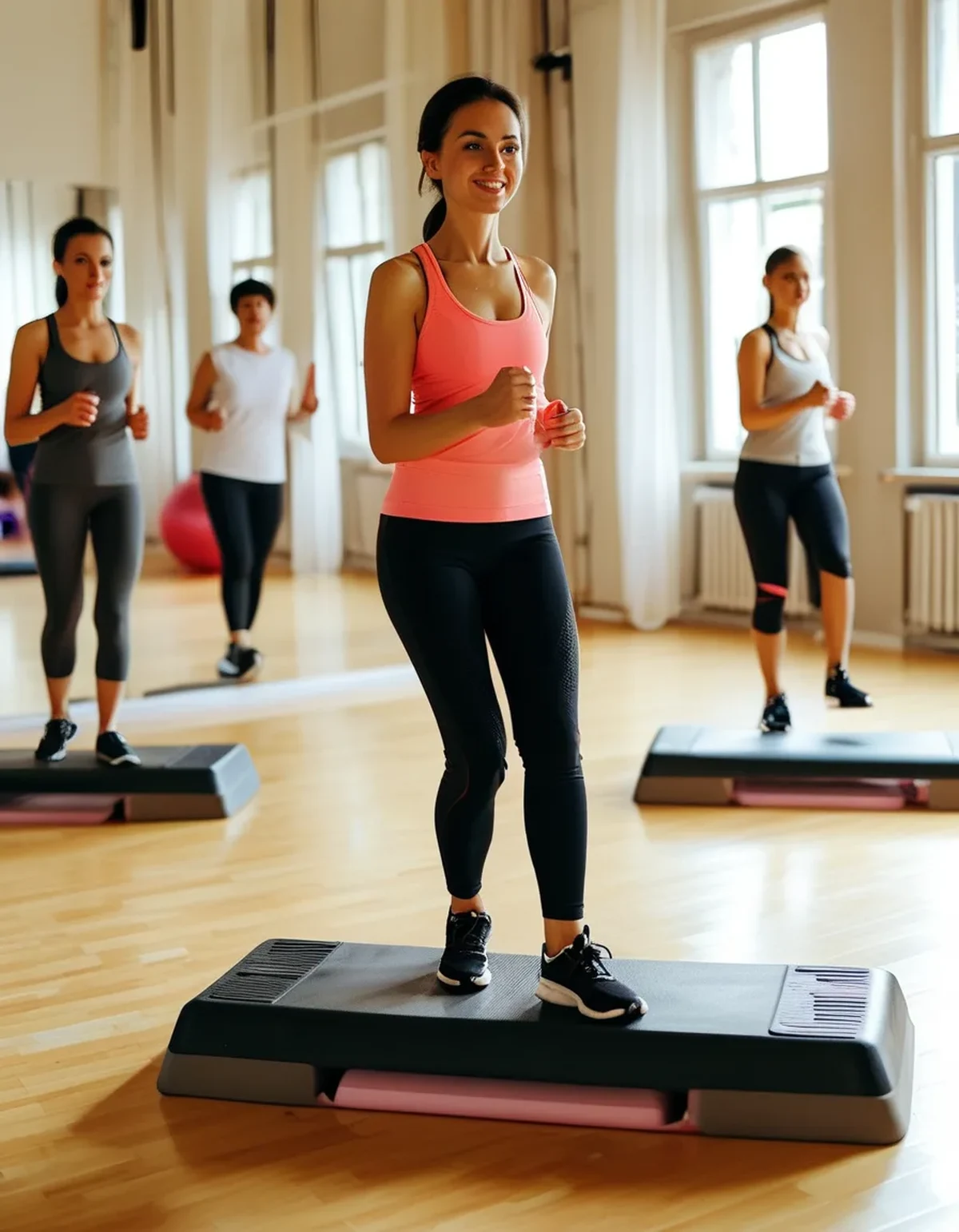
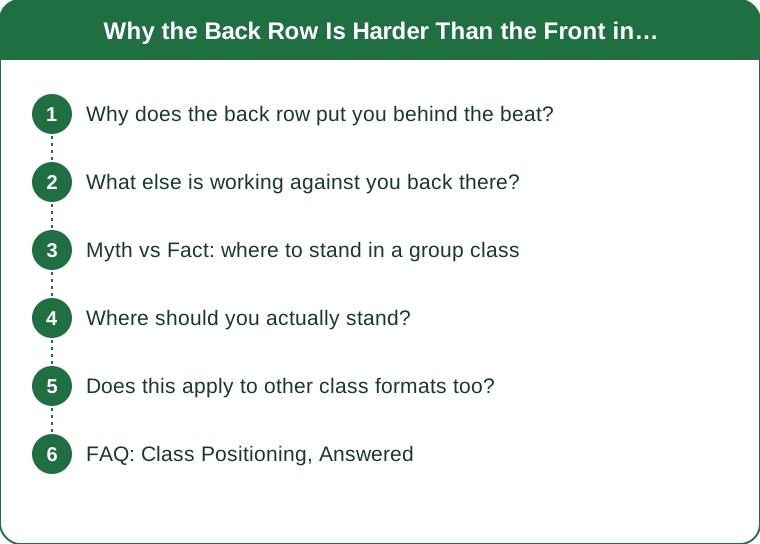
Why does the back row put you behind the beat?
Because of what you are actually watching.
The instructor calls the next move roughly four to eight counts before it happens. In the front row you hear the call, see the instructor demonstrate, and execute.
In the back row your view of the instructor is partially blocked, so you supplement it by watching the people in front of you. And they are executing, not previewing.
That means you are taking your cue from the movement rather than from the instruction — which by definition happens after the beat starts, not before it.
The compounding effect: the person in front of you is also slightly behind if they are in the middle rows. You are copying a copy. In a busy class the back row can be a full beat or more behind the front, on every transition.
That gap is not a fitness problem. It is a latency problem, and it makes the class feel chaotic in a way that has nothing to do with your coordination.
This is also why the back row loses the combination specifically at transitions rather than during a repeated block. Repeated blocks give you time to catch up. Transitions do not.
What else is working against you back there?
Three things, and they are all structural rather than personal.
1. Mirrored cues get harder at distance. The instructor faces you, so their right is your left. Experienced participants automatically re-invert. From the back, with a partially obstructed view, you are re-inverting a movement you can only half see — and the error rate climbs sharply.
2. Sound arrives differently. Speakers are usually at the front. In a large studio the back row hears the music marginally later and, more importantly, hears the instructor’s voice competing with the music at a worse ratio. Verbal cues are the ones you need most and they are the ones you lose first.
3. Floor and spacing. Back rows are often near doors, walls or storage, with less space per person. Less space means smaller travel moves, which changes the choreography you can actually perform and puts you further out of sync.
And one that is genuinely underrated: the back row usually has the worst view of the instructor’s feet, which is where all the step information is. Watching an upper body tells you the arm pattern. The feet are the class.
Myth vs Fact: where to stand in a group class
Myth: Beginners should stand at the back. Fact: This is the most repeated and least useful advice in group fitness. Beginners need the best possible view and the clearest cues, which is the front half. The back is the correct place for people who already know the choreography.
Myth: Standing at the front means everyone watches you. Fact: Everyone at the front is watching the instructor. The people most likely to be watching you are behind you — which is to say, standing at the front means fewer people can see you, not more.
Myth: The mirror solves the sightline problem. Fact: Only partially, and it introduces a second inversion to process. In a crowded class the mirror is also mostly full of other participants.
Myth: Being behind the beat means you need better coordination. Fact: Latency and coordination feel identical from the inside, which is why so many people conclude they are bad at choreography. Move forward two rows and see whether the problem follows you.
Myth: The back row is a lighter workout. Fact: Often the opposite. Constantly recovering the combination means more stopping, restarting and half-moves — which is more mentally exhausting and frequently less aerobically consistent than doing the class properly at the front.
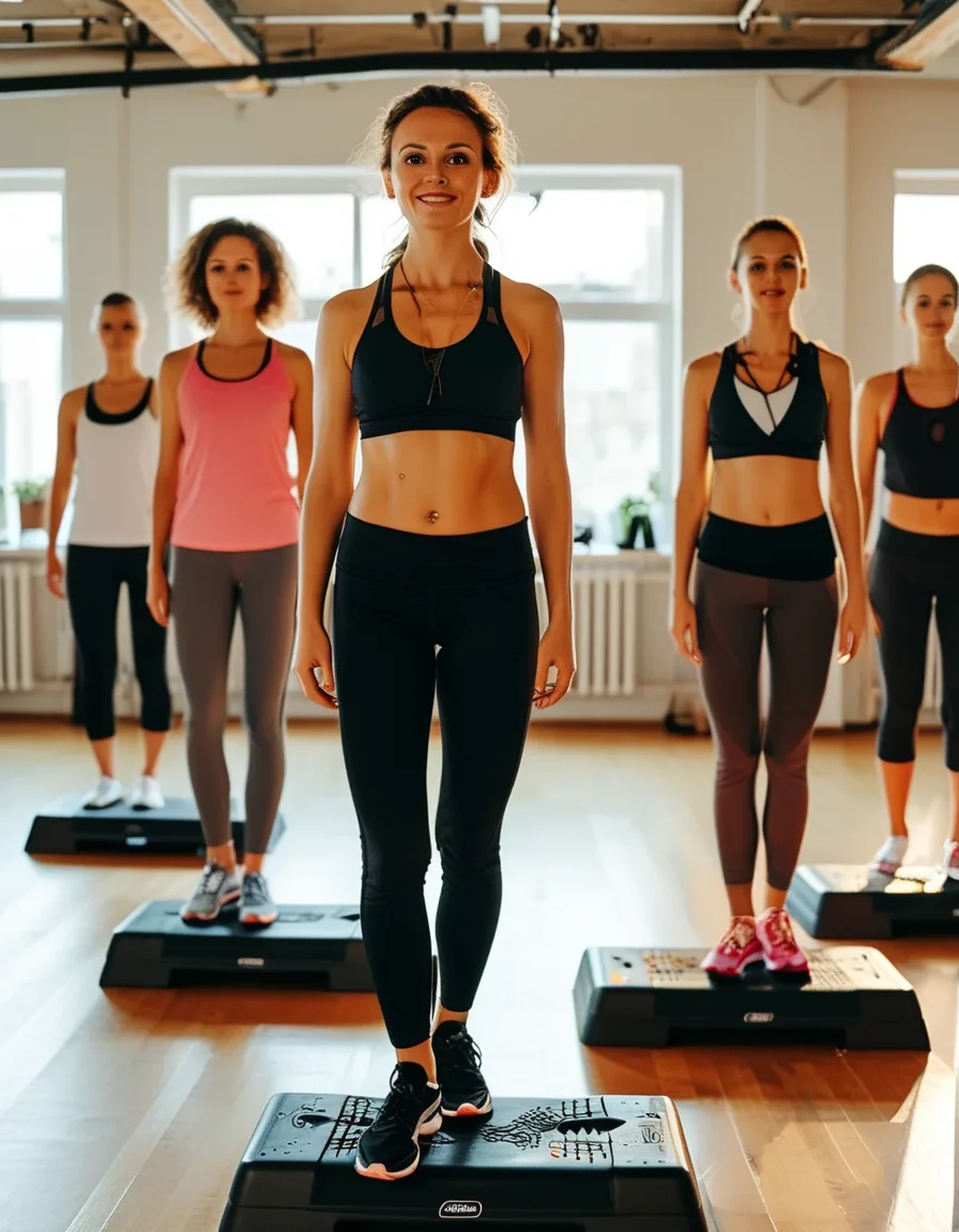
Where should you actually stand?
Second row, slightly off-centre. That is the answer for most people, most of the time.
Why not the front row: you cannot see anyone else at all, which removes a useful backup when you lose a cue. The front row is best for people who are confident with the choreography and want maximum instructor visibility.
Why the second row: clear sightline to the instructor’s feet over the shoulder of the person in front, plus the ability to glance sideways or forward when you lose the thread. Best of both.
Why slightly off-centre: directly behind the instructor is often the most obstructed position, because you are behind the person who chose the very front centre spot. A little to one side gives you an angled view that is usually clearer.
Practical steps if the front feels uncomfortable:
- Move one row forward at a time, not five. A single row is a small enough change that it does not feel like a statement.
- Arrive five minutes earlier. Position is decided by arrival time, and the people at the front are usually just the ones who got there first.
- Do it in a class you already know. Changing position and choreography at once is harder than either alone.
Give it three classes. The first will feel exposed, the second normal, and by the third most people find they are simply following the class rather than chasing it.
Does this apply to other class formats too?
To some formats strongly, and to others barely at all.
Strongly affected — anything with sequential choreography: step, dance fitness, aerobics, combat-style classes. These depend on receiving a cue before the move, so latency is genuinely costly.
Moderately affected — anything with technique that needs watching: barre, some HIIT formats, kettlebell classes. You want to see the demonstration clearly, but the moves usually hold for long enough to catch up.
Barely affected — anything self-paced or held: yoga, pilates, spin, most circuit formats. There is no combination to lose, and the instructor’s cues are descriptive rather than predictive. Stand wherever you like in these.
The rule of thumb: if the class has a combination that changes, position matters. If it has exercises that repeat, it does not.
One autumn-specific note: classes get considerably busier from September as people return to routines, and busier classes make the back row worse — more bodies blocking sightlines, more competing noise, less space. If you have been comfortable at the back through a quiet summer, the same spot will be measurably harder in six weeks’ time. Move forward before the rooms fill up, not after.
FAQ: Class Positioning, Answered
What if the front rows are always taken?
Arrive earlier — it is the only real answer, and five minutes is usually enough. Failing that, take an end position in a middle row, which gives you an angled sightline past the people in front.
Should I tell the instructor I am new?
Yes, and it matters more than position. Instructors who know there is a newcomer will cue more explicitly and often face the room more. It costs thirty seconds before class.
Does this mean I have been bad at step for no reason?
Possibly. Latency and poor sightlines produce exactly the experience of being uncoordinated. Try two classes from the second row before concluding anything about your ability — most people find the difference immediate and surprisingly large.
TL;DR:
- The back row copies a copy, so you are consistently behind on transitions — it is latency, not coordination.
- You also get worse sightlines to the feet, delayed and muddied verbal cues, and less space.
- Second row, slightly off-centre is the best position for most people.
- Move one row forward at a time, in a class you already know, and give it three sessions.
- Classes get busier from September, which makes the back row worse — move before the rooms fill.
If you have spent months assuming you are bad at choreography, this is worth ruling out first because it costs nothing and takes one class to test. A great many people who describe themselves as hopeless with combinations turn out to have been standing in the hardest place in the room.
Keep Reading
This article is for general informational and styling purposes only. Fit, sizing, and product availability may vary.