Why Your Knees Notice Step Height More Than Your Lungs Do
Quick Answer: Raising the platform increases the range of knee flexion you work through, and joint forces climb steeply as knee angle deepens. Your heart rate rises modestly with an extra riser, but knee compressive load rises far more, especially on the descent. Choose your height by the angle of your working knee, not by what your neighbour is using — a rough guide is a step height that keeps the knee at or above 90 degrees at the top.
One extra riser. Barely two inches.
Your breathing says it is basically the same class.
Your knees, three days later, disagree.

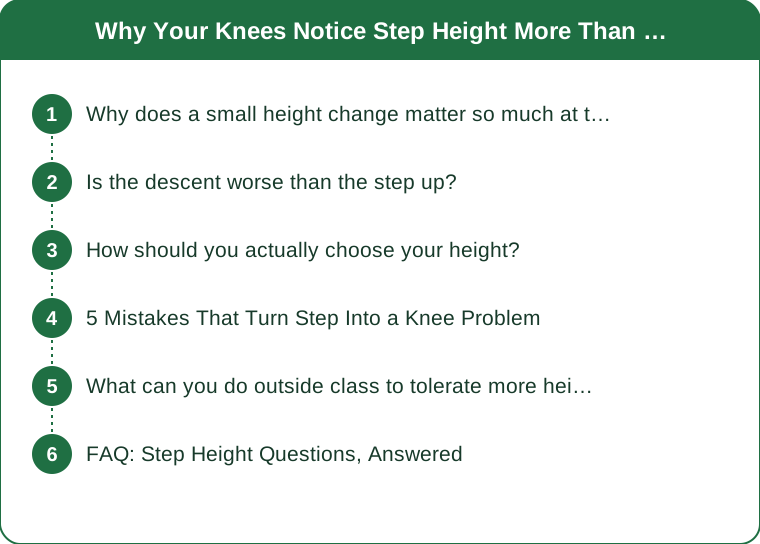
Why does a small height change matter so much at the joint?
Because the relationship between knee angle and joint force is not a straight line.
As the knee bends further, two things happen together: the moment arm the quadriceps have to work against gets longer, and the patellofemoral contact force — the pressure between kneecap and thigh bone — increases substantially. Research on stair climbing and step-ups consistently finds joint contact forces rising sharply as flexion deepens past roughly 60 to 70 degrees.
Meanwhile, the metabolic cost is simply a matter of mass times height times frequency. Adding two inches to a step adds a small percentage to the work you do per repetition, which your cardiovascular system absorbs almost invisibly.
So the two systems scale differently. Cardio cost goes up a little. Joint load goes up a lot. That mismatch is exactly why the wrong height is easy to miss during the class and obvious two days afterwards.
Is the descent worse than the step up?
Usually, yes, and it gets very little attention.
Stepping up is a concentric action — the muscle shortens as it produces force. Stepping down is eccentric — the muscle lengthens under load, controlling the descent against gravity. Eccentric contractions generate higher forces for the same effort and are the primary driver of delayed onset muscle soreness.
In a typical step class, you descend as many times as you ascend, at a tempo set by the music, often while turning or adding an arm pattern. That is a large volume of controlled eccentric work at a fixed cadence you did not choose.
The practical implication is that if your knees complain after step, the answer is not necessarily fewer classes. It is often a lower platform so that the same volume of descents happens through a shallower, better-tolerated range.
How should you actually choose your height?
By the angle at the top, not by the number of risers.
Stand on the platform with your working leg fully loaded and have someone look at your knee from the side, or film it. A knee angle at or above 90 degrees — meaning the thigh is roughly parallel to the floor or higher — is a sensible ceiling for most people doing high-repetition step work.
A few factors shift where that lands:
Leg length. Taller participants can generally take a higher platform for the same knee angle, which is why copying the person next to you is a poor method.
Class intensity. For a fast-tempo, high-repetition class, err lower. Volume multiplies whatever load you have chosen.
Current knee status. If a knee is irritable, drop a riser before you drop the class. Most people find they keep almost all of the cardiovascular benefit.
How new you are. If you are returning after a break of more than a month, spend two or three classes on the base platform before adding height back, even if you used risers before.

5 Mistakes That Turn Step Into a Knee Problem
1. Matching the height of the most experienced person in the room. Their knee angle is not your knee angle, and they may have been building tolerance for years.
2. Landing on the ball of the foot on the platform. Your whole foot should land on the step, heel included. A heel hanging off the back shifts load onto the knee and calf and is one of the most common faults in a busy class.
3. Descending heavily and quickly. Controlled descent is where the knee is protected. If the tempo forces you to drop rather than lower, the tempo or the height is wrong for you today.
4. Adding height at the same time as adding a new combo. Change one variable at a time. New choreography already increases the odds of a mistimed landing.
5. Ignoring the first twinge because the class is nearly over. Knee irritation in a repetitive-impact class does not improve over the remaining ten minutes. Step off, lower the platform, and rejoin.
What can you do outside class to tolerate more height?
If you want to work at a higher platform, build the capacity deliberately rather than through the class itself.
Slow eccentric step-downs. From a low box, lower yourself over three seconds on one leg, tapping the heel lightly. Two to three sets of six to eight per leg, twice a week, builds exactly the quality that step classes demand.
Split squats. These load the knee through a controlled range with a weight you choose, rather than a tempo the music chooses. Start bodyweight, three sets of eight per side.
Calf and quad tolerance work. Straight-leg and bent-knee calf raises support the ankle stiffness that keeps landings clean.
Give any of these four to six weeks before expecting a height change to feel comfortable. Tendon and joint tissue adapt on a slower timeline than the cardiovascular system does, which is the underlying reason your lungs are always ready before your knees are.
This is general information, not medical advice. Persistent knee pain, swelling or a knee that gives way should be assessed by a qualified professional.
FAQ: Step Height Questions, Answered
Is the base platform with no risers too easy?
Not if you use it properly. Increasing tempo, arm involvement, or the proportion of travelling moves raises intensity without raising joint load. Height is only one of several dials, and it is the one with the steepest joint cost.
Should I lower the step as I get tired late in class?
It is a genuinely good idea and almost nobody does it. Form degrades with fatigue, and the last fifteen minutes at a lower height is a better session than the last fifteen minutes with sloppy landings.
Does a cushioned floor make higher steps safer?
It helps with impact, but it does not change the knee flexion angle, which is the main driver here. A sprung floor is a bonus, not a licence to add risers.
TL;DR:
- Joint load rises much faster than cardio cost when you add risers, which is why the change feels small and costs a lot.
- The descent is the harder half, because eccentric loading generates higher forces and drives soreness.
- Set height by knee angle at the top — 90 degrees or above — not by what others are using.
- Build tolerance with slow eccentric step-downs and split squats over four to six weeks before adding height.
Your lungs will always tell you the class was fine. They are not the part of you that has to absorb two hundred landings.
Keep Reading
This article is for general informational and styling purposes only. Fit, sizing, and product availability may vary.