Why Your Step Class Results Stall Once the Choreography Gets Familiar
Quick Answer: Unfamiliar choreography costs energy in two ways: hesitation and correction produce inefficient movement, and the cognitive load itself raises effort. Once you know a routine, you move more economically and the same class burns less. The fix is to change the variables - riser height, arm patterns, travel, and tempo - rather than to wait for a new routine.
The first month of step class was transformative. You were breathless, sore, and visibly changing.
Six months in you know every combination, you can hold a conversation through the third one, and nothing much is happening.
You did get fitter. You also got much better at the class, and the second one is doing more of the work than the first.

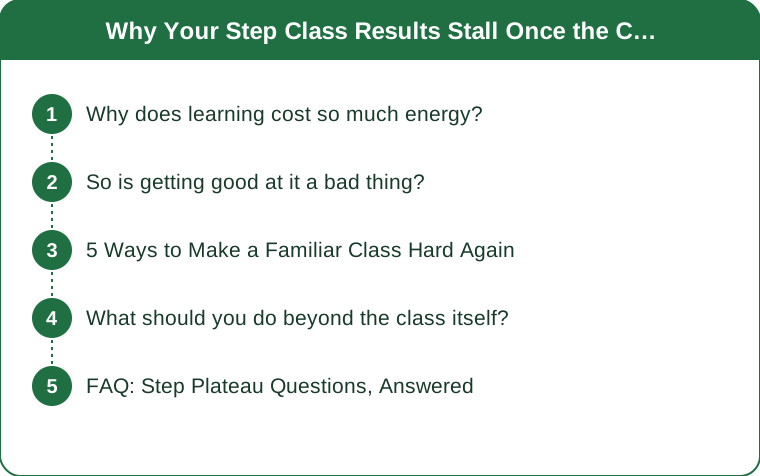
Why does learning cost so much energy?
Two separate mechanisms, and both of them go away as you learn.
Movement inefficiency is the larger one. A novice doing unfamiliar choreography makes constant small corrections - hesitating, adjusting mid-step, taking an extra weight shift to get back on the beat. Every correction is additional muscular work that produces no useful movement.
An experienced participant moving through a known routine does none of that. The steps are pre-planned, the weight shifts are minimal, and the whole pattern is executed with far less wasted motion. That is skill, and skill in movement means economy - doing the same task for less energy.
Cognitive load is the smaller but real second one. Learning and executing an unfamiliar pattern under time pressure raises arousal, heart rate, and perceived effort. A class that feels demanding partly because you are concentrating hard is genuinely more demanding, and that component disappears entirely once the routine is automatic.
The result is that the same class, same platform, same music, costs a practised participant meaningfully less than a new one. Nothing about the class changed and the training stimulus fell.
This is not unique to step - it is the general principle behind why any skill-based exercise gets easier faster than pure fitness would predict. Step is just an unusually clear case, because the choreography is fixed and repeats for weeks.
So is getting good at it a bad thing?
No, and it is worth being clear about that, because the answer is not to deliberately stay bad at the class.
Movement economy is a genuine and valuable adaptation. Being able to move efficiently is what allows you to work at a higher intensity for longer, and it transfers to almost everything else you do.
The problem is not the economy. The problem is that the class did not get harder to compensate.
In a well-run progressive programme, as you become more efficient, the load goes up. In a drop-in group class, the routine changes every four to six weeks and otherwise stays exactly the same. So your capacity rises, your economy improves, and the demand stays flat - which is the textbook description of a plateau.
The other thing worth naming is that plateaus are partly perceptual. A class that used to feel hard now feels manageable, and that feeling is read as the class being ineffective. Some of it genuinely is a reduced stimulus. Some of it is that you have simply stopped noticing the work, which is what competence feels like.
The way to tell them apart is objective. If your heart rate during the same class has dropped substantially compared with three months ago, that is a real reduction in stimulus and it needs addressing.

5 Ways to Make a Familiar Class Hard Again
1. Add a riser. The most direct lever available, and the effect is larger than people expect - step height changes the work per step substantially, since you are lifting your body mass through a greater vertical distance several hundred times. Add one riser per side rather than two, and expect it to feel considerably harder for a couple of weeks.
2. Commit fully to the arms. Arm patterns in step are frequently done at half effort by experienced participants, because the legs are automatic and the arms feel optional. Full-range, deliberate arm movements raise heart rate meaningfully, particularly overhead patterns, and this is the free intensity most people leave on the table.
3. Travel bigger. Take the wider version of every travelling move, use the full length of the platform, and cover more ground on anything that moves around the step. More distance per repetition at the same tempo is more work.
4. Add power to the propulsive moves. Where the choreography allows a lift, jump, or repeater, do the higher version. Adding vertical displacement is the most efficient way to raise intensity without changing the routine at all.
5. Stop resting in the transitions. Experienced participants coast through the linking sections between combinations because they know what is coming. Those transitions are often a third of the class. Staying at full intensity through them changes the total workload more than any single move does.
What should you do beyond the class itself?
Two things: vary what you attend, and add what step does not provide.
Rotate instructors deliberately. Different instructors build different patterns, and an unfamiliar teaching style restores some of the learning cost that made the class hard in the first place. This is the easiest single change available and it costs nothing.
Take the new routine seriously when it changes. The first two weeks of a new choreography block are when the stimulus is highest. That is the time to be there consistently, not the time to skip because it is confusing.
Add resistance training, because step will not. Step is largely cardiovascular and it is bodyweight only, which means it will not continue to build strength once you are conditioned to it. Two strength sessions a week addresses the actual gap rather than trying to make a cardio class do a job it cannot.
Vary intensity across the week rather than doing the same class three times. Three identical moderate sessions produce less than one hard, one easy, and one moderate. If you attend several classes a week, make one of them deliberately harder - higher riser, full arms, full power - and one deliberately easier.
And measure something. A heart rate monitor across the same class over months tells you objectively whether the stimulus has fallen. It is the difference between adjusting because the numbers say so and adjusting because a class stopped feeling novel.
One caution on the riser: knees notice step height more than lungs do, and adding two risers at once is a common route to knee irritation. Add height gradually, and if a higher step produces knee pain rather than muscular effort, come back down. This is general information, not medical advice.
FAQ: Step Plateau Questions, Answered
How often should the choreography change?
Most programmes run four to six weeks per block, which is a reasonable balance between learning time and staleness. If your class has run the same routine for three months, that is a genuine reason to raise it or to look elsewhere.
Is it worth learning a harder version of the class?
Yes, and it is underused. Moving up to an advanced or intermediate class restores the learning cost, the movement complexity, and usually the tempo all at once. It will feel like starting again for a fortnight, which is exactly the point.
Does this apply to other group classes too?
To any class with fixed choreography, yes - dance-based classes, pump classes with a set release, and anything with a repeating format. The more skill-based the class, the faster the economy improves and the sooner the stimulus falls.
TL;DR:
- Unfamiliar choreography costs energy through correction and concentration, and both disappear as you learn the routine.
- Movement economy is a real adaptation - the problem is that the class did not get harder to match it.
- Add a riser, commit to the arms, travel bigger, add power, and stop coasting through transitions.
- Rotate instructors, attend consistently when the routine changes, and add strength training that step cannot provide.
Getting good at the class was the goal. The mistake is letting the class stay the same size while you got bigger.
Keep Reading
This article is for general informational and styling purposes only. Fit, sizing, and product availability may vary.