Do You Need a Step Platform, or Will Your Stairs Work?
Quick Answer: Stairs work for the cardiovascular part and fail for the choreography. A staircase gives you a fixed height you cannot adjust, no space to step around or across, and a landing surface with no cushioning — which rules out most step aerobics patterns and raises impact. If you want the cardio, stairs are a fine free substitute. If you want actual step aerobics, a platform’s adjustability and the clear space around it are the whole point, and it costs less than two classes.
You are looking at a step platform online and looking at the stairs eight feet away wondering why you would buy one.
Reasonable question, and the answer depends entirely on what you are actually trying to do. For cardiovascular work, the stairs are genuinely fine. For step aerobics as a practice, three specific limitations make them a poor substitute — and the second one is the one that causes injuries.
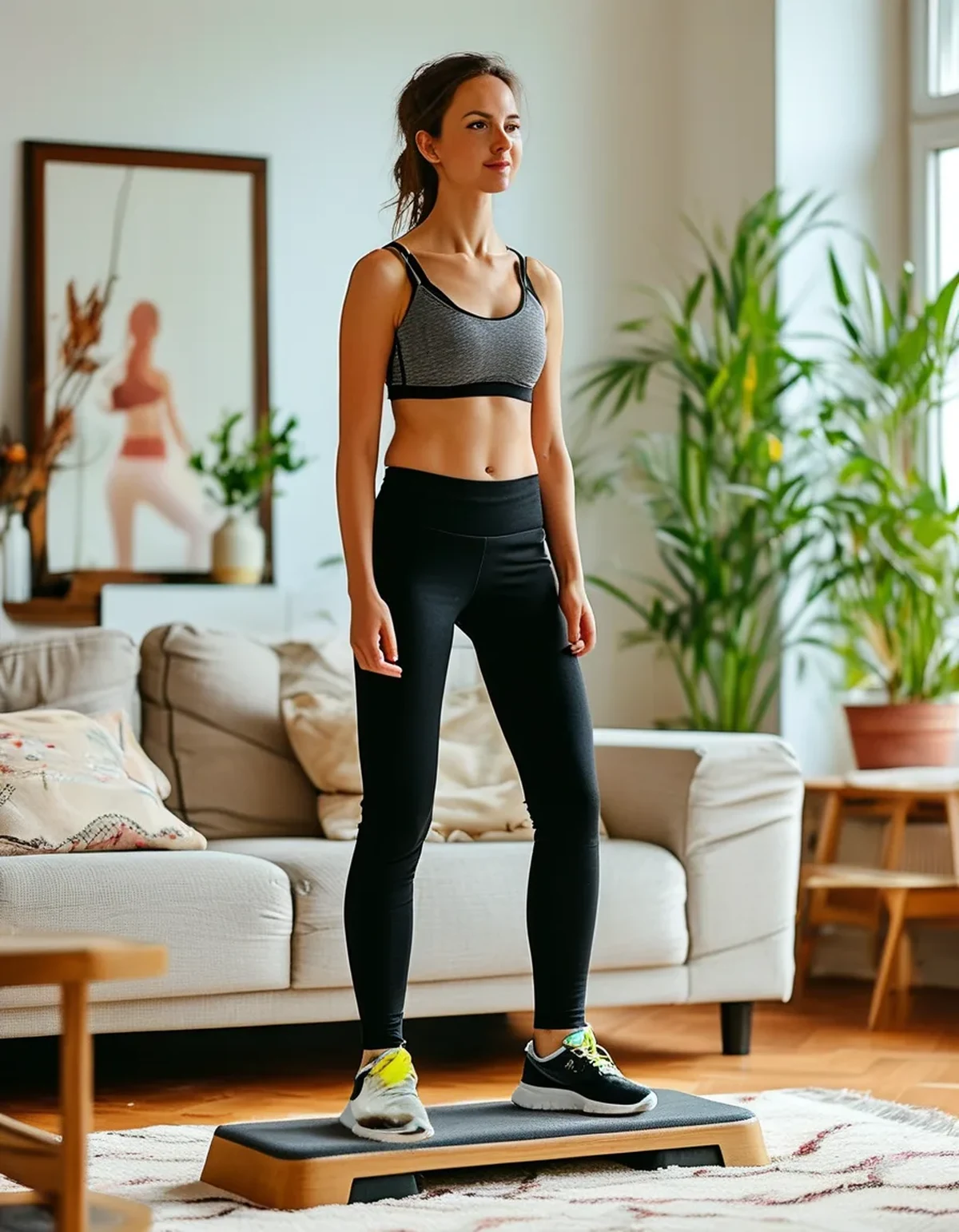
What do stairs actually do well?
More than the marketing for platforms would suggest.
Cardiovascular load. A staircase produces the same heart rate response as a platform at comparable pace, and often more, because typical stair rise is higher than a standard step height. If your goal is to get your heart rate up in a small space, stairs deliver.
Interval structure. Climb up, walk down, repeat. The descent is a natural recovery period, which makes stairs well suited to interval work with no planning required.
Availability and cost. They are already there, they take up no storage, and they cost nothing. For anyone unsure whether they will stick with the format, this is not a small consideration.
Basic strength work. Step-ups, calf raises off the edge of a step, incline push-ups with hands on a higher step, and split squats with the back foot elevated all work fine on a staircase.
For a straightforward cardio session, a staircase is a legitimate piece of equipment and many people use nothing else.
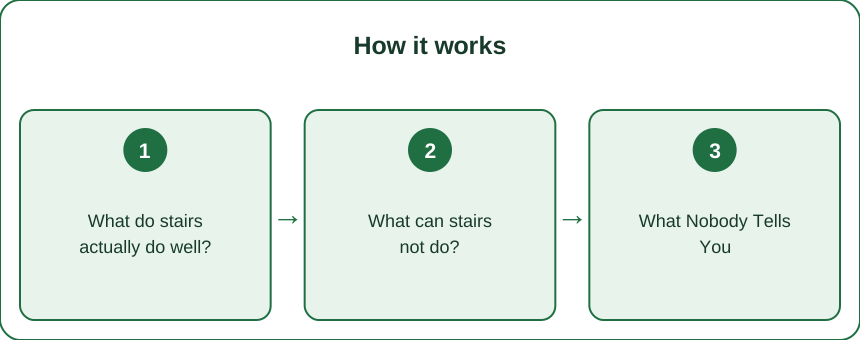
What can stairs not do?
Three things, and they are what step aerobics actually is.
1. Adjustable height
A platform’s risers let you change the step height in increments, typically from about 4 inches up to 10 or 12. That adjustability is not a convenience feature — it is the primary variable controlling both intensity and knee load.
A standard staircase rise is around 7 to 7.5 inches and cannot be changed. For a beginner, or anyone with knee sensitivity, that is often too high. The general guidance is that your knee should not bend beyond about 90 degrees when you step up, and for shorter people or those new to the movement, a fixed 7-inch rise breaks that rule immediately.
This is the source of most step-related knee complaints, and on stairs you have no way to adjust it.
2. Space around the step
Step aerobics uses the platform from multiple directions — you step over it, across it, along its length, around its ends, and turn on it. A staircase can only be approached from one direction and only from the front.
That removes the large majority of step choreography. What remains is basic up-and-down, which is cardio rather than step aerobics.
3. A forgiving surface
Platforms have a textured, slightly cushioned top surface designed for repeated impact and grip. Stairs are wood, tile, or carpet over a hard subfloor — harder on joints over a sustained session, and depending on the surface, meaningfully more slippery.
There is also the safety issue nobody mentions. Missing a step on a platform means stepping onto the floor. Missing a step on a staircase means falling down a flight of stairs, and doing repeated fast footwork while fatigued at the top of one is a genuinely poor idea.
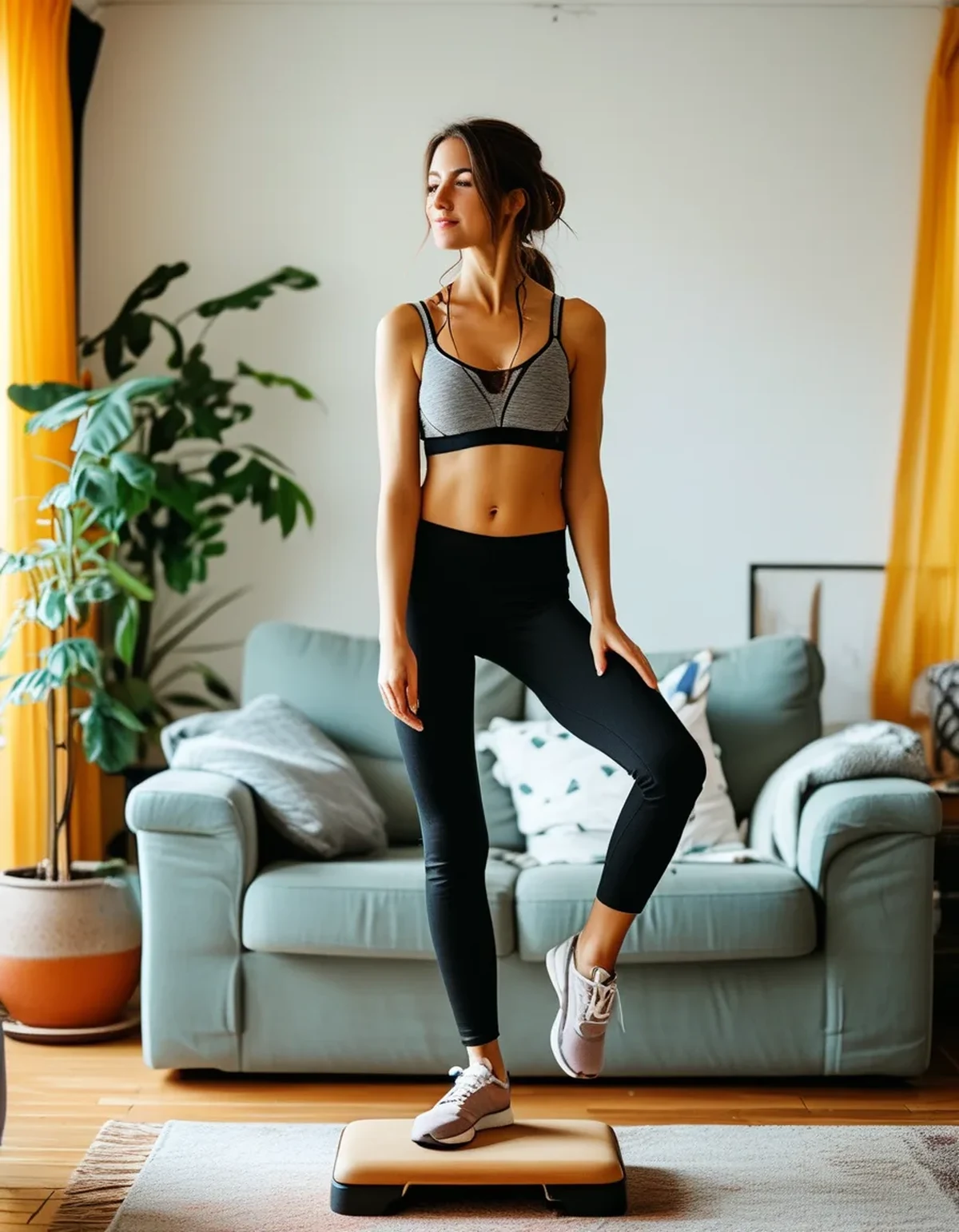
What Nobody Tells You: shoes matter more than the surface you are stepping on
Here is the thing that determines whether either option treats your joints well, and it is not the step.
Footwear is the largest controllable variable in step work, and it is more important than platform height, choreography, or session length.
The mechanics explain why. Step work involves repeated impact loading, considerable lateral and rotational movement, and a great deal of forefoot loading during the descent. That combination needs three things:
Forefoot cushioning specifically. Running shoes are built for heel-strike cushioning and are frequently thin under the forefoot. In step work you land forefoot-first repeatedly, so a running shoe is the wrong tool despite being what most people wear.
Lateral support. Running shoes are built to move forward, not sideways. Step aerobics is full of lateral movement, and a shoe with a soft, unsupported upper allows the foot to roll over the sole edge.
A flexible forefoot with a stable heel. Cross-training shoes are designed around this combination and are the correct category.
The most common cause of shin discomfort in step work is footwear, not step height — the shin muscles work hard to control the descent of the foot, and inadequate cushioning and support makes them work harder.
The related point for anyone using stairs: grip is the failure mode. Carpeted stairs with a smooth-soled shoe, or wooden stairs in socks, is how people get hurt. If you use stairs, wear proper cross-training shoes with a grippy outsole, and use the lowest step with the floor as your base rather than working partway up a flight.
Which is actually a good compromise worth naming: use the bottom step only, with clear floor in front of it. You get a fixed but reasonable height, an open space to work in, and no consequence for a missed step beyond stepping onto the floor.
Myth vs Fact: platforms and stairs
Myth: A higher step is a better workout. Fact: Higher increases intensity and knee load together. Beyond roughly 90 degrees of knee bend, you are adding joint stress rather than useful training. Most people are better served by more speed or more arm movement at a lower height.
Myth: A step platform is expensive equipment. Fact: A basic adjustable platform costs about the same as two studio classes and lasts years. Among home fitness equipment, it is at the very cheap end.
Myth: Stairs are more intense so they must be better. Fact: They are higher, which is not the same thing. For step aerobics specifically, the constraint on stairs is that you cannot do the movement pattern at all, which makes the intensity comparison irrelevant.
Myth: You need to change your step height as you get fitter. Fact: Progression usually comes better from choreography complexity, pace, and arm involvement. Height is the variable with the most joint cost per unit of intensity gained.
Myth: Any trainers will do. Fact: Cross-training shoes for lateral support and forefoot cushioning. Running shoes are the most common choice and the wrong one for this format.
FAQ: Step Platform Questions, Answered
What height should a beginner start at?
The platform with no risers — around 4 inches — is the standard starting point, and there is no rush to add. Spend a few weeks establishing the movement pattern before increasing height, and use the 90-degree knee rule as your ceiling regardless of what a class is doing.
Can I use a sturdy box or a low bench instead?
Only if it is genuinely stable, wide enough to land the whole foot on, and has a non-slip surface. Most household furniture fails at least one of those. The stability requirement is not negotiable — a box that shifts under a fast step is how ankles get sprained.
Is step aerobics hard on the knees generally?
It does not have to be. The risk factors are excessive step height, letting the knee travel well past the toes, landing hard, and inadequate footwear — all controllable. Keeping the knee bend at or under 90 degrees, stepping quietly, and wearing cross-training shoes addresses nearly all of it. If you have an existing knee condition, check with a physiotherapist before starting. This is general information, not medical advice.
TL;DR:
- Stairs work well for cardio, intervals, and basic strength — free, available, and effective.
- They cannot do step aerobics: no adjustable height, no space to move around the step, and a hard, sometimes slippery surface.
- The fixed 7-inch stair rise exceeds the 90-degree knee rule for many people, which is where knee complaints come from.
- Footwear matters more than the step surface. Cross-training shoes, not running shoes.
- Good compromise: use the bottom step only, with clear floor in front of it.
If you want to get your heart rate up, the stairs are already there. If you want the format, buy the platform — the adjustability is the entire product.
Keep Reading
This article is for general informational and styling purposes only. Fit, sizing, and product availability may vary.