Does Step Aerobics Actually Improve Balance and Coordination Over the Long Term?
Quick Answer: Yes, step aerobics genuinely builds balance and coordination over time, primarily through repeated practice of quick weight shifts, directional changes, and precise foot placement on and off an elevated platform — these specific demands train proprioception and dynamic balance in ways that steady-state cardio like a treadmill or stationary bike generally doesn’t.

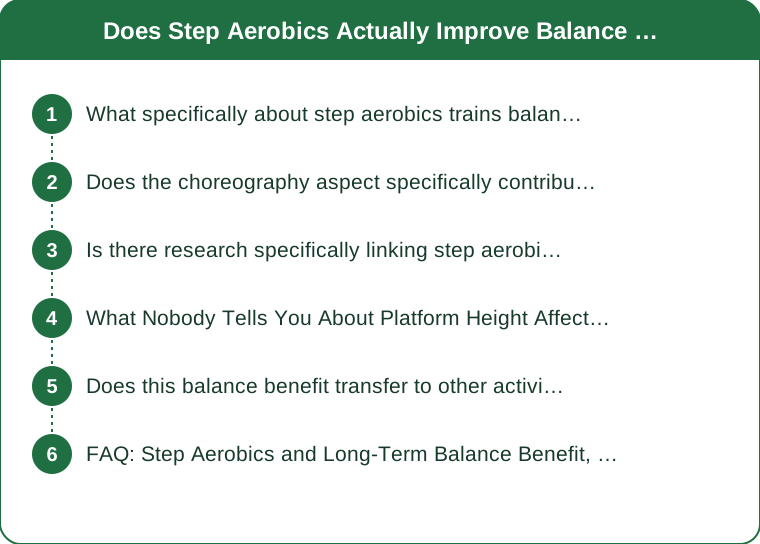
What specifically about step aerobics trains balance differently than other cardio?
Stepping on and off an elevated platform repeatedly, often while changing direction and combining movement patterns, requires continuous small balance corrections and precise foot placement that steady, repetitive cardio movements (running in a straight line, pedaling a stationary bike) don’t demand — this variability and directional complexity is the core mechanism behind step aerobics’ balance benefit.
Does the choreography aspect specifically contribute to coordination benefits?
Yes — learning and executing multi-step choreographed sequences trains coordination between visual processing, memory recall, and motor execution simultaneously, which is a more complex cognitive-motor task than simply repeating a single movement pattern, and this combined demand is part of why step aerobics is sometimes specifically recommended for coordination training beyond pure cardiovascular benefit.
Is there research specifically linking step aerobics to reduced fall risk?
Some research on step-based exercise programs, particularly for older adults, has found associations with improved balance measures and reduced fall risk — the mechanism is believed to be the repeated practice of dynamic weight shifts and quick postural adjustments, which directly train the same balance systems relevant to preventing falls in daily life.

What Nobody Tells You About Platform Height Affecting the Balance Training Effect
A higher platform demands more significant weight shift and balance correction with each step than a lower platform, meaning platform height isn’t just about workout intensity — it also scales the balance training difficulty, and progressively increasing platform height over time can be a deliberate way to advance the coordination and balance challenge, not just the cardio intensity.
Does this balance benefit transfer to other activities, or stay specific to step aerobics itself?
Balance and coordination improvements from step aerobics generally do transfer to other activities requiring dynamic balance (other sports, daily activities like navigating uneven surfaces), since the underlying proprioceptive and postural control systems being trained are general systems, not movement patterns specific only to step platforms.
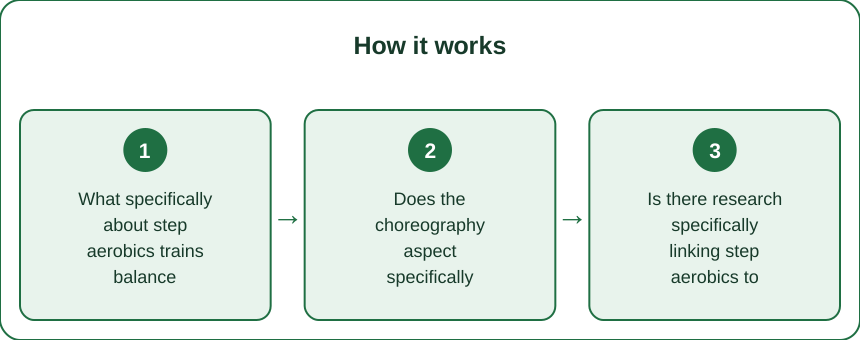
FAQ: Step Aerobics and Long-Term Balance Benefit, Answered
How long does it typically take to notice a measurable balance improvement?
Most research on balance training suggests measurable improvement within 6-12 weeks of consistent practice, though noticeable subjective improvement in coordination confidence can happen somewhat sooner for many people.
Does step aerobics benefit balance more for older adults or younger adults?
Both groups show benefit, though the relative importance is often higher for older adults given balance and fall-risk concerns that become more relevant with age.
Is step aerobics a good complement to dedicated balance training, or a replacement for it?
It’s a strong complement — combining step aerobics with dedicated single-leg balance work provides broader coverage than either approach alone, since each trains overlapping but not identical aspects of balance and coordination.
TL;DR:
- Repeated weight shifts and directional changes on an elevated platform train dynamic balance directly
- Choreography adds a coordination benefit by combining memory, visual processing, and motor execution
- Some research links step-based exercise to improved balance measures and reduced fall risk
- These benefits generally transfer to other activities, not just performance within step class itself
It’s a genuine, evidence-supported balance and coordination benefit — not just a side effect claimed by marketing.
Keep Reading
This article is for general informational and styling purposes only. Fit, sizing, and product availability may vary.