Does Step Aerobics Count as Strength Training?
Quick Answer: Partly, and mostly at the beginning. Step aerobics loads your legs with your bodyweight repeatedly, which produces real strength gains for anyone starting out or returning after a break. But because the load never increases beyond your bodyweight and the rep ranges are very high, it trains muscular endurance far more than maximal strength — and the strength adaptation plateaus within a couple of months. It counts, and it does not replace resistance training.
You are stepping up onto a platform hundreds of times with your whole bodyweight. It seems like that should build something, and it does. Just not indefinitely.

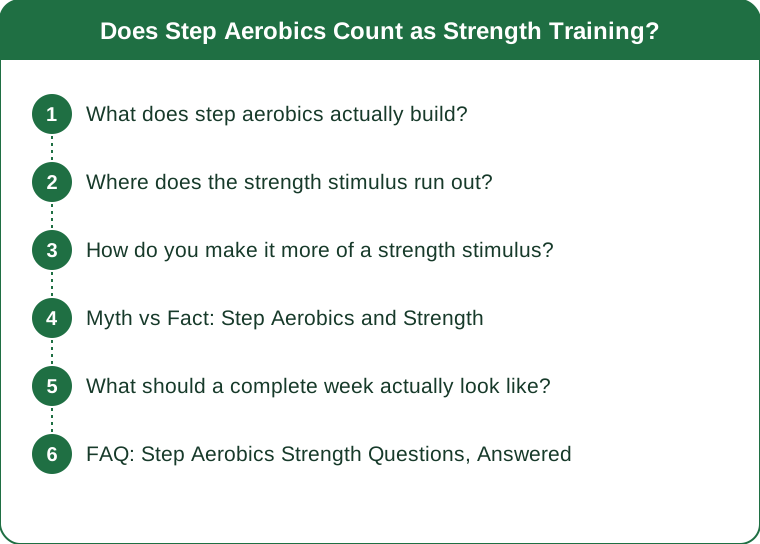
What does step aerobics actually build?
Cardiovascular fitness first, muscular endurance second, and some real strength if you are undertrained.
The primary adaptation is cardiovascular, and it is substantial. A step class keeps your heart rate elevated for 45 minutes with continuous large-muscle work, which is close to an ideal cardio stimulus.
The leg work is genuine. Every step-up is a single-leg loaded movement — you are lifting your entire bodyweight with one leg, which is not trivial. Over a class you might do several hundred of these, split across both legs. The quadriceps, glutes, and calves all work hard.
For a beginner, that produces real strength gains. Someone who has not trained legs will get stronger from step aerobics, measurably, in the first six to twelve weeks. Strength adaptations early on come substantially from the nervous system learning to recruit muscle better, and any consistent loading produces that.
The ceiling arrives because the load never changes. Progressive overload — gradually increasing the demand — is what drives continued strength adaptation. In step aerobics, your bodyweight is fixed, so once you have adapted to it, the strength stimulus stops increasing even though the workout still feels hard.
What it keeps building indefinitely: cardiovascular fitness, muscular endurance, coordination, and balance. What it stops building: maximal strength and, eventually, muscle size.
Where does the strength stimulus run out?
Around the point where you can complete a full class comfortably, which is usually six to twelve weeks in.
The mechanism is straightforward. Muscle grows and strengthens in response to a demand it is not currently equipped for. Once your legs handle repeated bodyweight step-ups without approaching failure, the movement is no longer a strength stimulus — it has become endurance work.
The rep range tells the story. Strength adaptation is driven most effectively by sets in roughly the 1–8 rep range at high load, and hypertrophy across roughly 6–20 reps. A step class puts you in the hundreds. That is squarely endurance territory.
The tell that you have hit the ceiling: the class still feels demanding cardiovascularly, but your legs are no longer sore and no longer the limiting factor. When your lungs quit before your quads, the leg stimulus is submaximal.
This is not a criticism of step aerobics. It is doing exactly what it is designed to do. The problem only appears when it is someone’s only lower-body training and they expect it to keep building strength for years.
Two things do keep progressing and are worth crediting: coordination, which improves for a very long time and has real value; and bone density, since weight-bearing impact work is genuinely protective and matters increasingly with age.
How do you make it more of a strength stimulus?
Increase the load or increase the difficulty per rep. Both are available.
Raise the platform. This is the most direct lever. Adding a riser increases the range of motion and the work done per step, and it disproportionately increases glute and hamstring involvement. Going from two risers to four is a meaningful jump in demand.
Be careful here, though: a platform too high for your knee flexibility causes the front knee to travel excessively and increases loading through the joint. The general guideline is that your front knee should not bend beyond roughly 90 degrees when your foot is on the platform. If it does, the step is too high for you regardless of your fitness.
Add external load. A weighted vest is the cleanest option — it distributes weight centrally and leaves your arms free for choreography. Light dumbbells work for upper body and do little for the legs, because the loads used in a step class are far too small to matter for the muscles doing the work.
Slow the eccentric. Controlling the step down instead of dropping into it increases time under tension considerably. This is hard to do in a choreographed class and easy to do practicing alone.
Add single-leg emphasis. Repeaters — repeated step-ups on the same leg — concentrate the work rather than alternating it, and they are already a standard step move.
And the honest answer: all of these help at the margin, and none turn a step class into a strength workout. If leg strength is a real goal, add two short resistance sessions a week rather than trying to make one modality do everything.

Myth vs Fact: Step Aerobics and Strength
Myth: If your legs are sore after class, you built strength. Fact: Soreness indicates unfamiliar or high-volume work, not strength adaptation specifically. Hundreds of repetitions produce soreness in a well-trained person too, and it tells you very little about whether the stimulus was sufficient to drive strength gains.
Myth: Adding hand weights makes it strength training. Fact: The weights used in group fitness classes — usually one to three pounds — are far below the load needed for strength adaptation in the shoulders and arms, and they contribute essentially nothing to the legs. They increase heart rate and can increase shoulder joint stress in high-rep overhead movements. Not harmful, not strength training.
Myth: High reps build lean muscle and heavy weights build bulk. Fact: This is one of the most persistent myths in fitness and it is not how muscle works. Muscle growth depends primarily on mechanical tension and total volume, and heavy training in a moderate rep range builds muscle more efficiently than very high-rep work. Nobody gets bulky by accident.
Myth: Cardio and strength cannot be trained at the same time. Fact: They interfere somewhat at high volumes and coexist perfectly well at the volumes most people train. A step class three times a week and two strength sessions is a well-balanced program, not a conflict.
Myth: Step aerobics is outdated. Fact: It is a weight-bearing, coordination-heavy, joint-friendly cardio modality with excellent adherence. Those are all things the research consistently says matter. Its reputation problem is aesthetic rather than physiological.
What should a complete week actually look like?
Step for what it is good at, resistance work for what it is not.
A structure that covers everything:
- Two to three step classes a week for cardiovascular fitness, coordination, and leg endurance
- Two short resistance sessions, 30 to 40 minutes, covering squats or a squat variation, a hinge, a push, and a pull
- One genuinely easy day — walking, mobility, nothing measured
The resistance sessions do not need to be complicated. Three sets of eight on four movements, adding a small amount of weight when eight becomes comfortable, is a complete program for most people and takes half an hour.
Order matters if they are on the same day. Resistance first, step after — for the same reason as any other pairing, the thing you do first gets your best effort, and heavy squats on step-fatigued legs are both less effective and less safe.
Progress the step work too, rather than doing the same class forever. Add a riser. Try repeaters. Take a faster class. The people who plateau are the ones repeating an identical stimulus for a year, which is true in every modality.
And one thing step does that lifting does not: the coordination and reaction demand of following choreography is genuine cognitive and neuromuscular training, and it holds up as a real benefit over decades. That is not a consolation prize — balance and coordination are among the things that matter most for staying capable later, and a barbell does not train them.
If you have knee or hip issues, get the platform height checked by an instructor before adding risers. This is general information, not medical advice.
FAQ: Step Aerobics Strength Questions, Answered
Will step aerobics tone my legs?
It will build muscular endurance and, early on, some real strength — and visible definition depends mostly on body composition rather than on the exercise itself. Step contributes on the energy expenditure side and does relatively little for building the muscle underneath, which is the part that creates shape. Both together is the answer.
Is a higher platform always better?
No, and it is the most common way people get hurt in step. Height should be limited by your knee comfort and your ability to control the step down, not by ambition. If your front knee bends much past 90 degrees, or if you push off the back foot to get up, the platform is too high.
Can I skip leg day if I do step three times a week?
You can, and you will hit a ceiling on strength within a couple of months while continuing to improve cardiovascularly. If maintaining leg strength as you age is a priority — and for most people it should be — two short resistance sessions a week alongside step is a far better use of the same total time.
TL;DR:
- Step aerobics does build real leg strength in beginners, for roughly the first six to twelve weeks
- The load is capped at your bodyweight, so the strength stimulus plateaus while the cardio benefit keeps going
- Raise the platform, add a weighted vest, or use repeaters to extend it — within safe knee range
- Hand weights under three pounds are not strength training in any meaningful sense
- Keep the step classes and add two 30-minute resistance sessions; they cover different things
It counts, and it counts for a while rather than forever. The coordination and bone-loading benefits keep paying out long after the strength curve flattens, which is a genuinely good trade — it just is not the same as a set of squats.
Keep Reading
This article is for general informational and styling purposes only. Fit, sizing, and product availability may vary.