Why Step Aerobics Choreography Feels Off When the Music Tempo Changes
Quick Answer: Step choreography is built around counting beats, not fixed foot patterns — when tempo (BPM) changes, the same sequence has to compress or stretch into fewer or more beats, which breaks muscle memory built at a different speed. Recount the pattern in beats rather than trying to match your old rhythm.
You finally got the combo clean at your regular instructor’s usual tempo. Then a sub plays it 10 BPM faster and the whole routine falls apart — not because you forgot the steps, but because your body memorized a speed, not just a pattern.

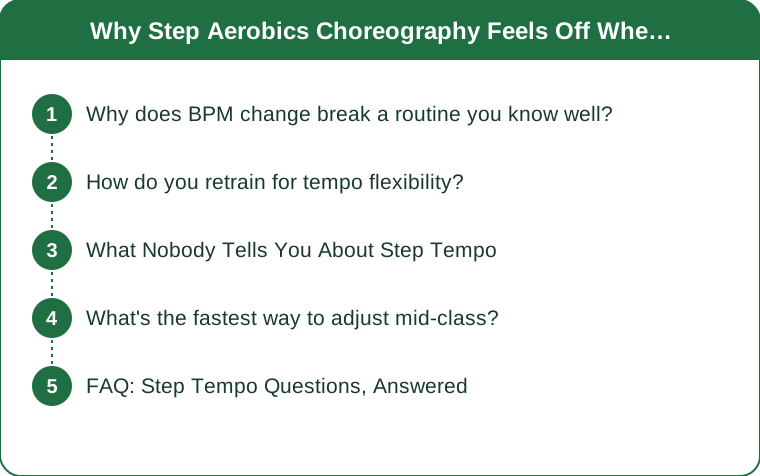
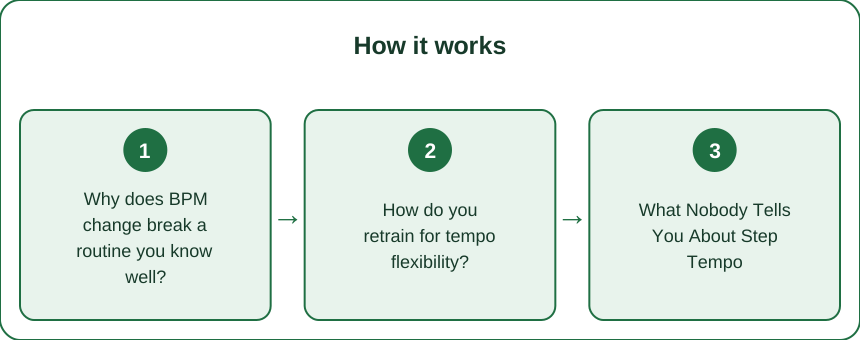
Why does BPM change break a routine you know well?
Because most people learn choreography through rhythmic muscle memory tied to a specific tempo, not through consciously counting beats. When BPM shifts, the same 8-count sequence now takes a different amount of real time to execute, and your body’s trained timing no longer matches.
This is why experienced steppers who count beats explicitly (rather than just ‘feeling’ the rhythm) adapt to tempo changes faster — they’re tracking the actual structure, not just a memorized speed.
How do you retrain for tempo flexibility?
Practice the same combo at 3 different tempos deliberately — slow (118-122 BPM), standard (124-128 BPM), and fast (130-134 BPM) — even just a few times each. This breaks the tie between the pattern and one specific speed.
Counting out loud (even just in your head, ‘1-2-3-4, up-up-down-down’) while practicing reinforces the beat structure over the felt rhythm, which is the actual transferable skill.

What Nobody Tells You About Step Tempo
Standard step aerobics tempo typically runs 118-128 BPM, but instructors and studios vary meaningfully within and beyond that range — a 10 BPM difference between two instructors’ ‘normal’ pace is common and not unusual or wrong on either end.
This means the frustration of ‘this instructor’s routine feels different’ isn’t really about instructor quality — it’s a genuine tempo mismatch with your trained pace, and it happens to experienced steppers just as much as beginners.
What’s the fastest way to adjust mid-class?
Drop to a simplified version of the combo for the first 8-count while your ears and body sync to the new tempo, then rebuild complexity once the timing clicks — usually within 16-32 counts.
Watching the instructor’s feet rather than trying to recall your memorized pattern also helps, since it anchors you to the actual current tempo instead of the one in your muscle memory.
FAQ: Step Tempo Questions, Answered
What BPM is considered beginner-friendly for step aerobics?
Generally 118-122 BPM — slower tempos give more processing time for foot placement and reduce injury risk while learning new patterns.
Does higher tempo mean a harder workout?
Not necessarily in difficulty of choreography, but it does increase cardio intensity and reduces reaction time for foot placement, which raises the risk of missteps.
Why do some instructors use much faster music than others?
Personal teaching style and class goals vary — some prioritize cardio intensity (faster), others prioritize choreography clarity and injury prevention (slower). Neither is inherently more correct.
TL;DR:
- Choreography is muscle-memorized at a specific tempo — BPM changes break that timing even when you know the steps
- Practice combos at 3 different tempos deliberately to build tempo flexibility
- Standard step tempo (118-128 BPM) varies meaningfully between instructors — a mismatch isn’t your fault
- Mid-class, simplify for one 8-count while resyncing, then rebuild complexity
The steps aren’t the hard part — the beat structure is. Count it explicitly and tempo changes stop derailing you.
Keep Reading
This article is for general informational and styling purposes only. Fit, sizing, and product availability may vary.