Is Step Aerobics Actually a Great Cardio Workout, or Just Nostalgic?
Quick Answer: Step aerobics is legitimately effective cardio — a moderate-intensity class burns roughly 300-400 calories in 30 minutes, comparable to jogging, plus it adds coordination and lower-body strength that running doesn’t.
Step aerobics has come back around thanks to nostalgia and social media, but the question worth asking isn’t whether it’s trendy — it’s whether it actually does anything.

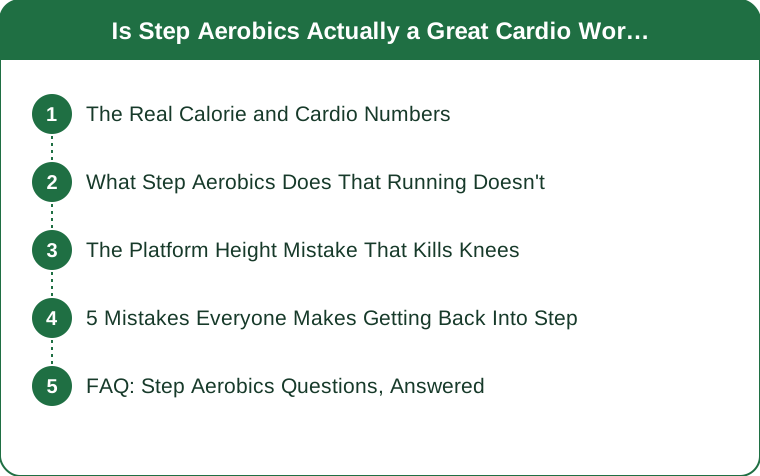
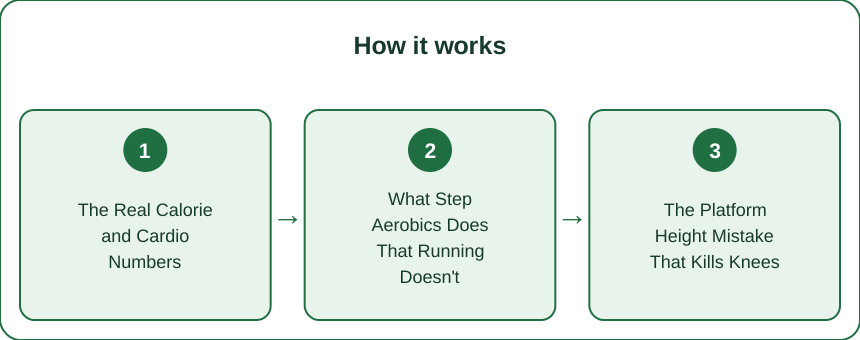
The Real Calorie and Cardio Numbers
A moderate-paced step class raises heart rate into zone 3-4 territory for most participants, similar to a steady jog. Over a 30-minute session, that translates to roughly 300-400 calories burned for most body weights, with the added benefit of near-zero impact compared to running on pavement.
What Step Aerobics Does That Running Doesn’t
Stepping up and down repeatedly builds glute and quad strength in a way flat-ground cardio doesn’t, because every step is a small unilateral leg press against gravity. It also demands coordination and rhythm tracking, which engages cognitive processing alongside the cardiovascular work — a combination linked to better long-term adherence for people who get bored with straight cardio.

The Platform Height Mistake That Kills Knees
Using a platform that’s too high for your height and mobility is the most common step aerobics injury cause. Your knee should stay behind your toes throughout the step-up — if you have to lean forward or your knee travels well past your foot to reach the platform, drop it down a level.
5 Mistakes Everyone Makes Getting Back Into Step
1. Choosing platform height based on the instructor’s setup instead of your own hip mobility. 2. Skipping the warm-up because it ‘feels too easy’ — cold ankles and knees are where step injuries happen. 3. Stepping flat-footed instead of rolling through the foot, which increases impact. 4. Ignoring arm movements, which is where a real calorie difference shows up. 5. Doing step every single day without rest — like any repetitive-impact cardio, joints need recovery days.
FAQ: Step Aerobics Questions, Answered
Is step aerobics good for beginners?
Yes, as long as you start with a low platform (4-6 inches) and basic step patterns before adding complex choreography.
Does step aerobics count as strength training?
It provides light strength stimulus for glutes and quads, but shouldn’t replace dedicated strength training if muscle building is a goal.
How often should I do step aerobics per week?
3-4 sessions per week with at least one rest day between is a sustainable range that avoids overuse strain on knees and ankles.
TL;DR:
- Step aerobics burns comparable calories to jogging with far less impact
- It uniquely builds glute and quad strength through repeated step-ups
- Platform height matched to your mobility is the key injury prevention factor
- 3-4 sessions weekly with rest days keeps joints healthy long-term
The nostalgia is real, but so is the workout — step aerobics earns its spot as legitimate cardio, not just a throwback trend.
Keep Reading
This article is for general informational and styling purposes only. Fit, sizing, and product availability may vary.