Why Step Aerobics Choreography Feels Impossible at First (and How to Actually Learn It)
Quick Answer: Step choreography feels impossible at first because your brain is tracking foot pattern, timing, and cardio effort all at once. Drill the foot pattern alone, without music or cardio effort, for 5 minutes before class — separating the skills makes them click far faster.
Your legs aren’t the problem in step aerobics — your working memory is. You lose the sequence around move three, catch back up by move six, and spend the whole class one step behind everyone else. That’s not a coordination issue. It’s a sequencing issue, and it has a specific fix.

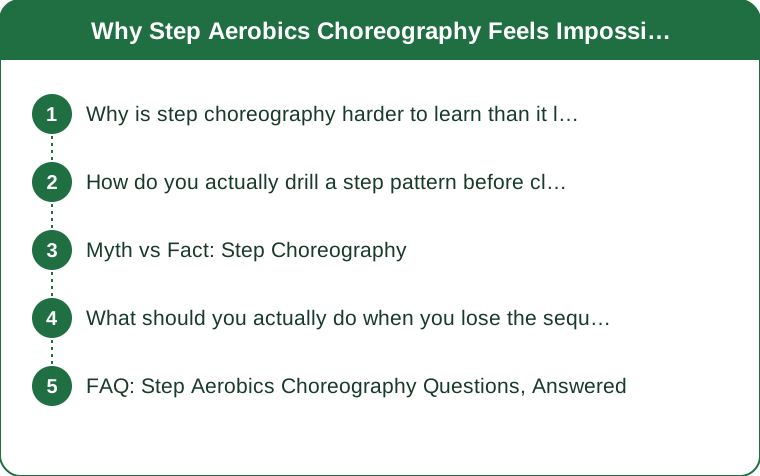
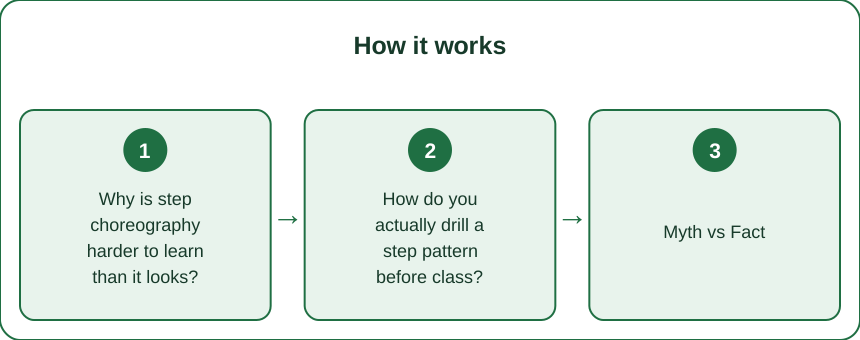
Why is step choreography harder to learn than it looks?
Because a typical step combo asks your brain to do three things simultaneously: remember the foot pattern, hit the music’s timing, and keep your heart rate up. Any one of those alone is manageable — stacked together, they overload short-term memory, especially in your first few classes.
Instructors who cue well can help, but the real fix happens before class, not during it.
How do you actually drill a step pattern before class?
Take the basic move — say, up-up-down-down — and walk through it slowly on flat ground with zero music and zero step platform, just to burn the foot pattern into memory without any other load on your brain.
Once that feels automatic, add the step platform, still slow, still no music. Only then add tempo. Each layer you add should feel almost boringly easy before you add the next one.

Myth vs Fact: Step Choreography
Myth: If you’re coordinated in other workouts, step should come naturally. Fact: Step choreography is a distinct skill — sequencing and spatial memory — that doesn’t automatically transfer from running, lifting, or even dance styles with different counting.
Myth: Standing in the front row helps you learn faster. Fact: The back row, where you can see the whole class moving as a reference, is usually easier for beginners than staring directly at the instructor’s mirrored moves.
Myth: You should keep up with the class from day one. Fact: Marking the pattern with smaller, lower-effort steps while you learn the sequence is normal and expected — full cardio effort comes after the pattern is automatic, not before.
What should you actually do when you lose the sequence mid-class?
Step in place and watch for two counts instead of guessing and stepping wrong — a wrong step off-platform is where ankle rolls happen. Rejoin on the next 8-count, which is how most choreography is structured to reset anyway.
This single habit — pause and watch instead of guessing — is the biggest difference between people who get frustrated and quit and people who stick with step long enough to actually learn it.
FAQ: Step Aerobics Choreography Questions, Answered
How many classes does it take to stop feeling lost?
Most people report a real shift around class 4-6, once several combos start repeating and feeling familiar rather than brand new every time.
Should I watch tutorial videos before class?
A short video of the specific move pattern can help, but drilling the foot pattern yourself, slowly and without music, works better than passive watching.
Is it normal to feel exhausted from the mental effort, not just the cardio?
Yes — tracking sequence and timing is genuinely tiring in a different way than cardio fatigue, and that mental exhaustion fades as patterns become automatic.
TL;DR:
- Choreography overload comes from stacking pattern, timing, and cardio at once
- Drill the foot pattern alone first — no music, no platform, no cardio effort
- Stand in the back row where you can see the whole class as reference
- When you lose the sequence, pause and watch rather than guess
- Most people click around class 4-6
Separate the skills before you stack them, and step choreography stops feeling impossible by your second week.
Keep Reading
This article is for general informational and styling purposes only. Fit, sizing, and product availability may vary.