Why Step Aerobics Choreography Still Trips You Up After Weeks of Classes
Quick Answer: Step choreography combines direction, platform side, and timing simultaneously, and beginners often try to memorize the full combination as one block rather than breaking it into smaller repeatable chunks — the fix is deliberately drilling 2-3 move segments in isolation before linking them, rather than only practicing the full sequence at class speed.
Weeks in, you’re still a beat behind on new combinations while others seem to pick them up instantly. That gap usually isn’t about rhythm or fitness — it’s about how the choreography is being mentally chunked (or not chunked) as you try to learn it.

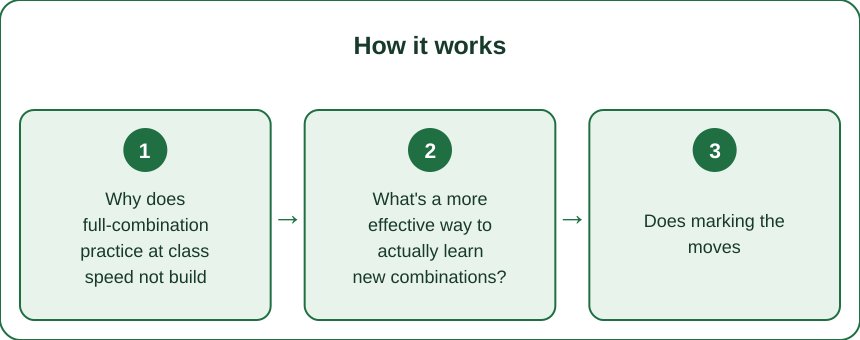
Why does full-combination practice at class speed not build lasting memorization?
Attempting to learn an entire 8-count or 16-count combination at full class speed asks your brain to encode direction, platform side, and timing all simultaneously under time pressure, which overloads working memory before the pattern has a chance to consolidate. Instructors demonstrating combos at performance speed are showing you the target, not necessarily the most effective way for a beginner to actually learn it.
What’s a more effective way to actually learn new combinations?
Break the combination into 2-3 move chunks and drill each chunk slowly and repeatedly in isolation before linking chunks together — this mirrors how most skill acquisition research suggests complex motor sequences are actually learned, chunk by chunk, rather than as one long block memorized all at once.
Does marking the moves (doing them smaller, without full step-ups) help during learning?
Yes, significantly — ‘marking,’ where you perform the footwork pattern without the full step height or power, lets you focus purely on the sequencing and direction of the pattern without also managing the physical demand of full step-ups simultaneously. Many experienced step instructors mark new combinations themselves before teaching them at full intensity, for exactly this reason.

What Nobody Tells You About Watching Feet Versus Watching the Instructor’s Face
Here’s a detail rarely coached directly: beginners who watch the instructor’s feet directly tend to learn combinations slower than those who watch overall body orientation and platform-facing direction, because feet alone don’t convey the upcoming direction change in time to react — by the time you see the foot movement, the direction change has already started. Watching the instructor’s hip and shoulder orientation gives an earlier visual cue to anticipate the next direction.
Myth vs Fact: Step Aerobics Choreography
Myth: Practicing the full combination repeatedly at class speed is the fastest way to learn it. Fact: Breaking it into smaller 2-3 move chunks and drilling those first typically builds memorization faster.
Myth: Watching the instructor’s feet closely is the best way to follow new steps. Fact: Watching hip and shoulder orientation gives an earlier cue for upcoming direction changes than feet alone.
Myth: If you’re still fumbling after several classes, step aerobics coordination isn’t for you. Fact: It usually reflects a learning-strategy gap (chunking, marking) rather than a coordination limitation.
FAQ: Step Aerobics Choreography, Answered
How many times should I drill a small chunk before linking it to the next?
Most people need 4-6 slow repetitions of a 2-3 move chunk before it’s ready to link smoothly with the next segment.
Is it okay to mark moves during an actual class instead of doing full step-ups?
Yes — most instructors expect and welcome marking during new or fast combinations; it’s a normal, accepted part of learning in real time.
Does arriving early to practice with the instructor help meaningfully?
Often yes, if the option exists — even a few minutes of walking through a new combination at reduced speed beforehand meaningfully reduces in-class fumbling.
TL;DR:
- Full-speed, whole-combination practice overloads working memory before patterns can consolidate
- Breaking choreography into 2-3 move chunks and drilling those first builds lasting memorization faster
- Marking moves (smaller, without full step height) lets you focus purely on sequencing while learning
- Watching the instructor’s hip and shoulder orientation gives an earlier direction cue than watching feet
Next class, try marking new combinations in smaller chunks rather than chasing the full sequence at class speed — that shift in strategy usually closes the gap faster than more repetition alone.
Keep Reading
This article is for general informational and styling purposes only. Fit, sizing, and product availability may vary.