Why Step Aerobics Leaves You More Breathless Than Running at the Same Pace
Quick Answer: Stepping is vertical work against gravity, which is metabolically expensive, and every step involves an eccentric landing too. Add arms above shoulder height — which raises heart rate disproportionately — plus constant direction changes and the cognitive load of following choreography, and a step class demands considerably more than steady running at a comparable perceived pace. Lower the platform or drop the arms before you slow the tempo.
Forty minutes of running is fine.
Twenty minutes of stepping and you cannot speak.
The workload is not what it looks like.
Why is stepping harder than it looks?
Four reasons, and they stack.
Lifting your body vertically is expensive. Raising your whole body mass onto a platform, repeatedly, is significant work. Running is largely horizontal with a modest vertical component; stepping is the reverse.
Platform height changes the cost substantially. Each additional riser adds meaningfully to the work per step. Going from a 6-inch to an 8-inch platform is a real jump in intensity, not a small adjustment.
Every step down is an eccentric landing. Your quads control the descent each time, which is why step classes produce quad soreness that flat running does not.
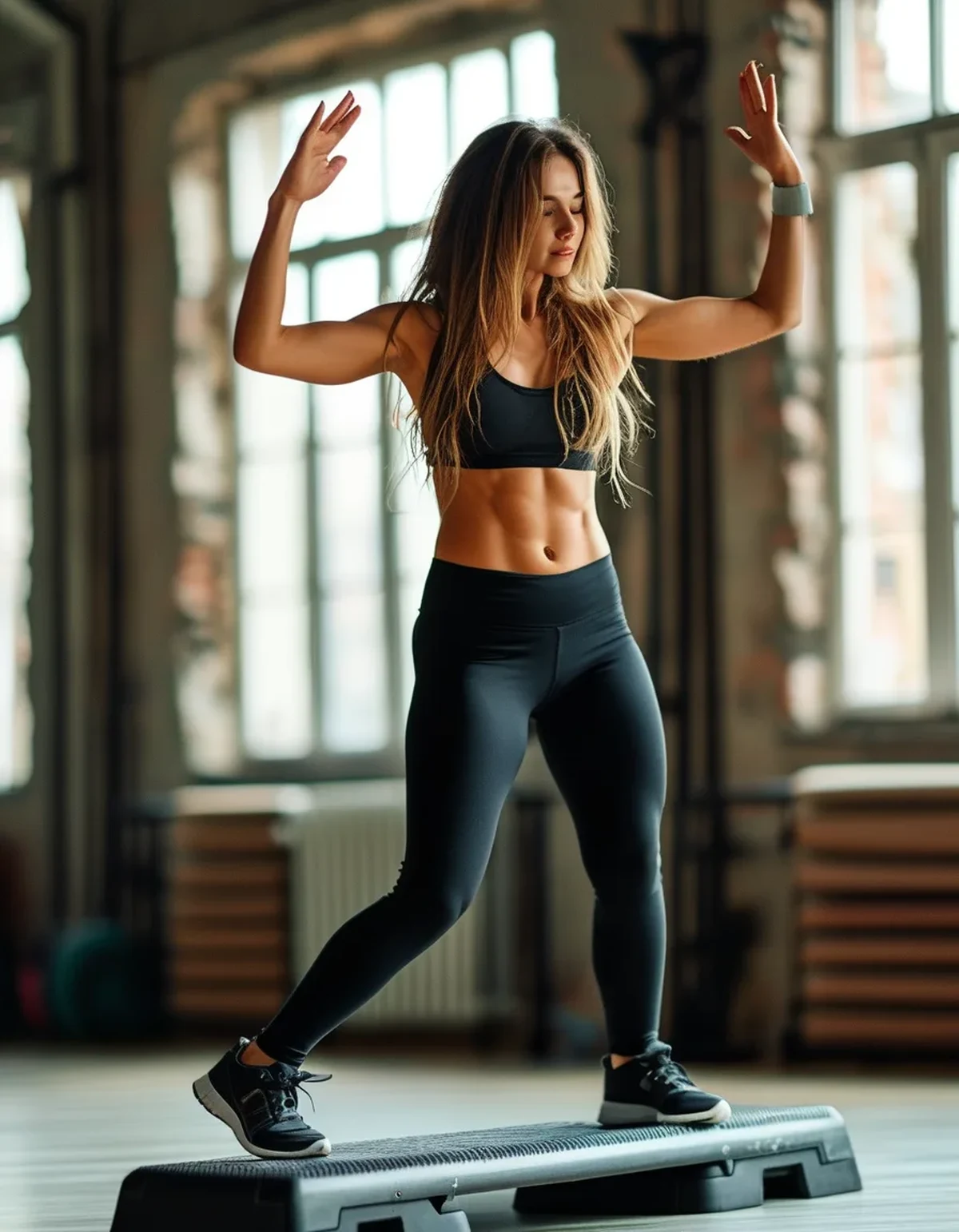
Arms above the head raise heart rate disproportionately. Working with arms overhead increases heart rate and blood pressure response substantially for relatively little additional muscular work. This is a large part of why the numbers look extreme.
Direction changes cost more than steady movement. Turning, pivoting and changing lead leg all require deceleration and reacceleration, which is more demanding than continuous motion.
And there is real cognitive load. Following choreography while moving raises effort in a way that running on a familiar route does not. Learning a new routine genuinely raises heart rate compared with performing a known one.
Why does the heart rate seem so high?
Because several things push it up beyond the muscular demand.
Arm position is the dominant factor. Arms overhead produce a disproportionate cardiovascular response. If your heart rate spikes during the arm-heavy blocks specifically, this is why.
Upper body work adds cardiovascular load efficiently. Smaller muscle groups working produce a relatively larger heart rate response per unit of actual output.
Studio temperature matters. Group fitness rooms run warm, and heat raises heart rate independently of workload — sometimes substantially.
Intervals happen whether or not they are labelled. Choreography naturally alternates intense and moderate blocks, so a class is effectively interval training even when described as steady.
Novelty raises effort. A new routine is measurably harder than a familiar one at the same tempo, purely from the cognitive and coordination demand.
The useful conclusion: do not judge your fitness by comparing step heart rate with running heart rate. They are different demands, and a high number in a step class is expected rather than alarming.

How should you adjust the intensity?
Six levers, in the order worth using them.
Change the platform height first. The highest-leverage adjustment there is. Dropping from 8 inches to 6 meaningfully reduces the work per step without changing anything else about the class.
Drop the arms before you slow the legs. Bringing arms below shoulder height reduces heart rate significantly while keeping the choreography intact. It is the most useful in-class adjustment and almost nobody uses it.
Keep the tempo, reduce the range. Staying on the beat but stepping with less lift preserves the rhythm and the coordination benefit at lower cost.
Take the low-impact option. Removing the jumps and propulsion steps cuts intensity and joint loading without stepping out of the class.
Learn choreography before adding intensity. Repeating a familiar routine at full effort is far more productive than struggling through a new one — the coordination load is doing nothing useful for fitness.
March in place when you need to. Stepping off for eight counts and rejoining is a normal, expected part of a class rather than a failure.
Seasonal note: studios get warmer as heating comes on in autumn, and the same class at the same platform height genuinely feels harder in October than in August. If your numbers jump without explanation, check the room before you question your fitness.
This is general information, not medical advice.
Myth vs Fact: Step Aerobics
Myth: step is a beginner workout. Fact: at an 8-inch platform with full arms and propulsion steps, it is a genuinely demanding session. The adjustability is what makes it accessible, not the baseline difficulty.
Myth: a higher platform is always better training. Fact: higher increases intensity and joint loading, and it degrades form as you tire. 6 inches with good form beats 8 inches with a collapsing pattern.
Myth: it is only cardio. Fact: the eccentric step-downs are a real lower-body stimulus, which is why quads get sore in a way flat running never produces.
Myth: your whole foot should land on the platform. Fact: yes, it should — and this is the most common technique error. Letting the heel hang off the back loads the calf and Achilles and is a genuine injury risk.
Myth: arms are just for show. Fact: arms overhead raise heart rate substantially. They are one of the main intensity dials in the class.
Myth: step is bad for knees. Fact: for most healthy knees it builds strength. Platform height and step-down control matter — existing knee pain warrants assessment before starting.
Myth: if you cannot follow the choreography you are unfit. Fact: coordination and fitness are separate. Most people need three or four classes before the pattern stops absorbing all their attention, and the workout improves substantially at that point.
FAQ: Step Aerobics Questions, Answered
What platform height should I use?
Start at 4 to 6 inches. Move up only when your form holds for a full class, and never at the cost of landing your whole foot on the platform.
Why is my heart rate so much higher than when running?
Vertical work, eccentric landings, arms overhead and choreography load. All four push it up. It is expected.
How do I lower intensity without leaving the class?
Drop your arms below shoulder height. Largest effect for the smallest change. Then reduce platform height, then take the low-impact option.
Why are my quads sore and not my calves?
Step-downs are eccentric quad work. If your calves are sore instead, check that your whole foot is landing on the platform.
How long before I can follow the choreography?
Three or four classes for most people. The workout gets considerably better once the pattern is automatic.
Is step good for building strength?
It provides a genuine lower-body stimulus, particularly the eccentric portion, but it is not a substitute for resistance training.
Can I do it every day?
Two or three times a week is sensible alongside other training. Daily eccentric loading needs a gradual build.
TL;DR:
- Stepping is vertical work against gravity plus an eccentric landing on every rep — far more costly than it looks.
- Arms overhead raise heart rate disproportionately, which explains most of the extreme numbers.
- Drop the arms before you slow the legs — biggest intensity change for the smallest disruption.
- Platform height is the main dial: 6 inches with good form beats 8 with a collapsing one.
- Whole foot on the platform, always. Heel hanging off is the classic injury cause.
Next class, keep your arms below shoulder height for one block and watch what happens to your heart rate. It is the fastest way to understand where the effort is coming from.
Keep Reading
This article is for general informational and styling purposes only. Fit, sizing, and product availability may vary.