Why Step Aerobics Makes Your Calves Sore but Not Your Quads
Quick Answer: Calf-dominant soreness almost always means you are stepping onto the platform with the ball of your foot rather than placing the whole foot down. That forces the calf to control every step-up and every controlled descent, while the quads and glutes barely engage. Full foot placement moves the work to the larger muscles where it belongs. Put your whole foot on the platform, every single time.
The muscle that is sore is the muscle doing the job.
If it is your calves, your feet are landing wrong.
Why does partial foot placement load the calf so heavily?
Because it turns every step into a calf raise under body weight.
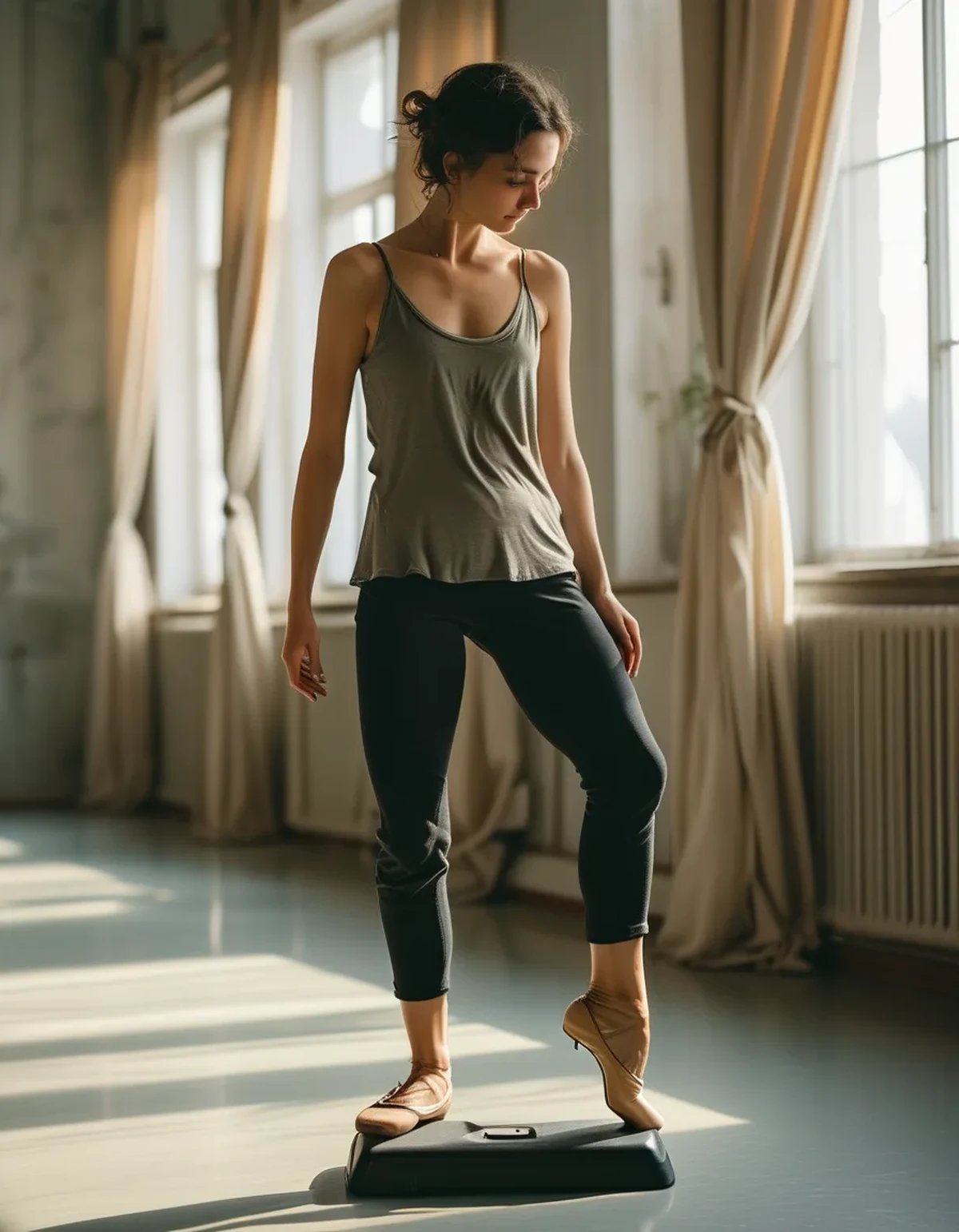
Stepping up on the ball of the foot means the heel is unsupported. The calf must contract to hold that position and to drive the body up, and it does so for every repetition of a forty-five minute class. That is several hundred loaded calf raises.
It also removes the quads and glutes from the movement. With the foot only partially on the platform, the knee and hip cannot extend through their full range effectively. The large muscles that should be doing the work are largely bypassed.
The descent is worse than the ascent. Coming down onto the ball of the foot means the calf is lengthening under load - eccentric contraction - which produces far more delayed soreness than the concentric work going up.
And the ankle takes the stability job too. A partially placed foot on a raised surface makes the ankle the primary stabiliser, adding fatigue on top of the force production.
It is often a spatial problem, not a technique preference. People step short because they are standing too far from the platform or because they are rushing to keep up with the music - both of which are easy to fix once noticed.
The other classic cause is a platform that is too high, which makes full placement genuinely difficult and forces a partial step.
How do you fix it in one class?
Four changes, all of which you can make in the first three minutes.
Place the whole foot on the platform, every step. Heel and toe both landing. This is the single change - if the platform is deep enough, there is no reason not to, and it immediately moves the work to your quads and glutes.
Stand closer to the platform. Roughly one foot-length away. Too far back is the most common cause of short stepping, and people rarely notice their own distance.
Lower the platform. Remove a riser. A step too high for your current strength or ankle mobility makes correct placement impossible - and a lower platform done properly is a far better workout than a high one done badly.
Step down toe-first, then heel, close to the platform. Stepping down too far away forces you onto the toes and increases both calf load and knee strain. Come down close.
Slow down if you need to. Half-tempo with correct placement beats full-tempo with partial. Rushing to match the music is what breaks foot placement for most people in a class setting.
And check your shoes. Very cushioned running shoes are unstable on a platform edge and encourage a tentative, toe-first landing. A flatter, more stable cross-training shoe genuinely improves foot placement.

What should the soreness pattern actually look like?
Spread across the large muscles, with a bias toward the ones you have been emphasising.
Quads and glutes should be the main sources. Step-ups are primarily a knee and hip extension movement, and those muscles should carry the load. Mild soreness there after a hard class is the expected outcome.
Hamstrings if there were a lot of knee lifts or kickbacks. Normal, and typically lighter.
Some calf involvement is fine. They stabilise and contribute, so mild calf soreness alongside quad soreness is nothing to worry about. It is calf-only or calf-dominant soreness that signals the technique issue.
Shin discomfort is a different signal. Aching at the front of the lower leg often means you are landing hard or stepping down too heavily, and it is worth addressing quickly since it can develop into a persistent complaint.
Knee pain is never a normal pattern. Pain at the front of the knee usually means the platform is too high, you are stepping down too far away, or your knee is travelling well past the toes on the step-up. Lower the platform and step closer.
And any pain that is sharp, one-sided, or lasts beyond a few days deserves a professional opinion rather than another class. This is general information, not medical advice.
Myth vs Fact: Step Aerobics and Muscle Soreness
Myth: Sore calves mean it was a good workout. Fact: it usually means your feet were landing wrong. Soreness indicates unaccustomed loading in one muscle, not overall effectiveness.
Myth: A higher platform is always a better workout. Fact: a higher platform mostly increases knee load and makes correct foot placement harder. Most people get more from a lower platform with clean technique and more intensity.
Myth: Step aerobics is only cardio. Fact: done with full foot placement, it is a genuine repeated single-leg strength stimulus for the quads and glutes - which is exactly what disappears when you step on your toes.
Myth: Stretching your calves after class prevents the soreness. Fact: stretching does not meaningfully prevent delayed onset soreness. Fixing the foot placement does.
Myth: You should feel it in your calves because you are on your toes for the moves. Fact: only some choreography involves deliberate toe work. The base step-up should be flat-footed, and treating toe-stepping as normal is how the problem persists for months.
Myth: If it stops making you sore, it stopped working. Fact: your body adapted, which is the goal. Progress it by raising intensity or adding a riser with good form - not by chasing soreness.
FAQ: Step Class Soreness, Answered
How high should my platform actually be?
Start with the base platform and no risers, and only add height when you can complete a full class with your whole foot landing and your knee staying behind your toes. Most beginners are on a platform too high for them, often because everyone else has risers on.
Why do my calves cramp during class?
Cramping mid-class points at sustained calf contraction from toe-stepping, and sometimes at hydration and electrolyte status. Fix the foot placement first - if cramps persist afterwards, look at fluids and consider speaking to a professional.
Should I skip class if I am still sore?
Mild soreness is fine to train through with light activity, and movement usually helps it. Significant soreness that changes how you move is worth a day off - stepping badly because you are sore is how technique problems get ingrained.
TL;DR:
- Calf-dominant soreness means you are stepping onto the ball of your foot, turning every rep into a loaded calf raise.
- The descent causes most of it - eccentric calf loading produces the deepest delayed soreness.
- Fix it with full foot placement, standing closer, a lower platform, and stepping down close.
- The correct pattern is quads and glutes, with mild calf involvement at most.
- Knee pain is never normal - lower the platform and check how far you are stepping down.
Next class, film ten seconds from the side on your phone. Whether your heel lands on the platform answers the whole question.
Keep Reading
This article is for general informational and styling purposes only. Fit, sizing, and product availability may vary.