Why Step Height Matters More Than the Choreography
Quick Answer: Step height is the single largest determinant of intensity in step aerobics — energy cost rises substantially with each riser level, far more than tempo changes do. It also determines knee load. The right height puts your knee at roughly 90 degrees or less at the top of the step; anything deeper increases joint force without a proportional fitness benefit.
You’ve been doing the same class for three months on the same platform, working hard on the combinations, and the workout doesn’t feel harder or easier than it did in week two. The choreography got more complex. The workload didn’t change.

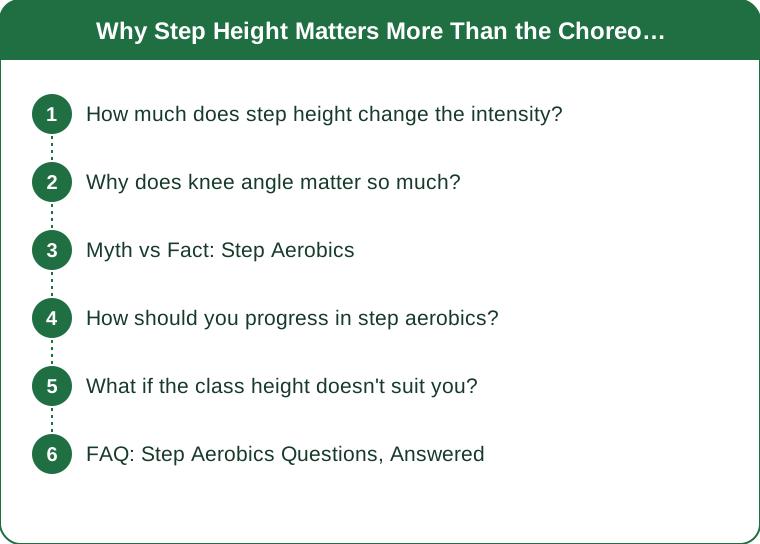
How much does step height change the intensity?
Substantially, and non-linearly.
The fundamental physics is the same as stair climbing: you’re raising your body mass by the platform height, repeatedly. Double the height and you roughly double the vertical work per step, before accounting for the additional muscular demand of the deeper knee angle.
Research on step aerobics energy cost has consistently found that platform height affects oxygen consumption more than cadence within the normal range of both. Adding one riser level does more than speeding up the music.
Typical heights:
- 4 inches (platform alone): beginners, deconditioned, or joint-sensitive participants
- 6 inches (one riser per side): most common general-fitness height
- 8 inches (two risers): experienced participants
- 10 inches: advanced, and above most people’s useful range
The knee angle test overrides the level. At the top of the step, your working knee should be at 90 degrees or more open. If you’re going deeper than that, the platform is too tall for your leg length regardless of your fitness.
Why does knee angle matter so much?
Because compressive force at the patellofemoral joint rises sharply past 90 degrees of flexion.
Stepping up is a single-leg loaded knee extension. The deeper the starting angle, the higher the force required and the greater the joint compression. At the same time, the mechanical advantage of the quadriceps decreases.
This is why tall platforms cause knee complaints in short participants and not in tall ones. It isn’t about fitness — it’s leg length relative to platform height. A 10-inch step is moderate for someone with long femurs and excessive for someone without.
The descent is the other half. Stepping down is an eccentric quadriceps action, and eccentric loading is where most delayed soreness and most joint stress originate. Higher platforms make the descent harder in a way that’s easy to underestimate mid-class.
Practical safety guidance: if your knee tracks inward as you step up, the platform is too high or you’re fatigued — both mean lowering it. If you’re stepping down heavily rather than controlling the descent, same conclusion.
This is general information, not medical advice. Existing knee issues warrant a professional assessment before adding height.
Myth vs Fact: Step Aerobics
Myth: Complex choreography means a harder workout. Fact: Complexity increases cognitive load and often decreases physical intensity, because participants slow down and hesitate while learning. The hardest step workouts are usually simple patterns performed continuously at the right height.
Myth: Faster music is the way to progress. Fact: Within the safe range — roughly 118 to 128 BPM for standard step — tempo changes intensity far less than height does. Beyond that range, form breaks down before intensity improves.
Myth: You should always face the front of the platform. Fact: Varying approach angles — side, corner, straddle — changes muscle recruitment and is part of why step programming works. It also reduces the repetitive-loading pattern of always leading with the same leg.
Myth: Step is a low-impact workout. Fact: It’s lower impact than running but it isn’t no impact. Ground reaction forces on the descent are meaningful, especially at higher platforms and with propulsion moves.
Myth: Arm movements meaningfully increase calorie burn. Fact: They add modestly and improve coordination and enjoyment, but the legs and the platform height do nearly all the work. Adding arms to a too-low platform doesn’t compensate.

How should you progress in step aerobics?
In a specific order, and height comes second rather than first.
Stage 1 — pattern competence. Learn the base moves cleanly at 4 to 6 inches. Basic step, V-step, knee lift, over the top, straddle. Full foot contact on the platform, controlled descent. This takes a few weeks and shouldn’t be rushed.
Stage 2 — continuity. Do the same patterns without stopping for 20 to 30 minutes. Continuity is where the aerobic benefit lives, and it’s what pausing to figure out choreography destroys.
Stage 3 — height. Add one riser level. Give it two to three weeks at the new height before considering another.
Stage 4 — power moves. Propulsion steps, repeaters, and lifts. These raise intensity considerably and also raise impact, so they come last.
What most people do instead is chase complexity from week two, which adds interest but not much fitness. If a class feels stale, the honest question is whether the platform has changed since you started.
A note on foot placement: the whole foot should land on the platform, with the heel down. Stepping on the ball of the foot only is the most common form error and it loads the calves and Achilles disproportionately.
What if the class height doesn’t suit you?
Use a different height than the room. This is normal and instructors expect it.
Go lower if: your knee bends past 90 degrees at the top, you’re stepping down heavily, you can’t keep up with the pattern at the class height, or you’re returning from a break.
Go higher if: the class feels easy at the end, your heart rate stays in a low zone throughout, or you’ve been at the same height for over two months without the workout feeling different.
Asymmetric adjustment is worth knowing about: if you can manage the height on most moves but not on power moves, keep the height and step the power moves down to the floor. Modifying the move is better than under-loading the whole class.
Room position matters too. Standing where you can see the instructor without turning your head reduces the neck strain that people accumulate in step classes and makes the pattern easier to follow, which keeps you moving continuously.
The overall point: the platform is your intensity dial and it’s under your control every class. Most people set it once on the first day and never touch it again, which is why the fifth month feels like the second.
FAQ: Step Aerobics Questions, Answered
How high should my step be if I’m short?
Use the knee angle test rather than a number. If a 6-inch platform puts your knee past 90 degrees, use 4 inches — that’s a leg-length fact, not a fitness limitation. Many shorter participants work at 4 to 6 inches indefinitely and progress through tempo and power moves instead.
Do I need step-specific shoes?
Cross-trainers with lateral support and a flexible forefoot. Running shoes are the common wrong choice — their cushioned, elevated heels are unstable for the lateral and pivoting movements in step choreography.
Is step aerobics still effective compared to newer formats?
Yes. It delivers sustained moderate-to-vigorous cardiovascular work with moderate impact and significant coordination demand. The format’s age says nothing about its physiology — the effectiveness depends entirely on height, continuity, and duration.
TL;DR:
- Platform height affects intensity more than tempo or choreography complexity.
- Keep the working knee at 90 degrees or more open at the top of the step.
- Progress in order: pattern competence, continuity, height, then power moves.
- Set your own height regardless of the room — it’s the dial you control.
If your class has stopped feeling like a workout, the answer probably isn’t a harder combination. Check what’s under the platform, add one riser, and give it three weeks.
Keep Reading
This article is for general informational and styling purposes only. Fit, sizing, and product availability may vary.